

If you want to know how much of your starting body weight you have lost, calculating your weight loss as a percentage gives you a clearer picture than looking only at pounds or kilograms. The calculation is straightforward: find the difference between your starting weight and current weight, divide that difference by your starting weight, and convert the result into a percentage.
For example, if you started at 200 pounds and now weigh 180 pounds, you have lost 20 pounds. Since 20 is 10% of your original 200-pound weight, your percentage of body weight loss is 10%.
You can calculate the percentage manually with a few simple steps, or use a weight loss percentage calculator to do the math for you. This guide explains how to figure out percentage of body weight loss, how the weight loss percentage formula works, how to calculate weight loss in percentage using pounds or kilograms, and how to interpret the result.
For quick calculations, you can also explore the health calculators available on CalculatorPeak.
How to Calculate Weight Loss Percentage
The standard way to calculate weight loss percentage is to compare the amount of weight you have lost with your starting weight.
First, determine how much weight you lost by subtracting your current weight from your starting weight. Next, divide the weight you lost by your starting weight. Finally, multiply the result by 100 to express it as a percentage.
In simple terms, the process is:
Starting weight → current weight → total weight lost → percentage of starting weight lost.
Suppose your starting weight was 200 pounds and your current weight is 180 pounds. You lost 20 pounds. The 20 pounds represents one-tenth of your original 200 pounds, so your body weight loss percentage is 10%.
This is the basic method used when people want to calculate weight loss in percentage, figure out percentage of weight loss, or determine what percentage of their original body weight they have lost.
How to Figure Out Percentage of Body Weight Loss
To figure out percentage of body weight loss, you need two measurements: your starting weight and your current weight.
Your starting weight is the weight you began with at the point you want to use as your baseline. Your current weight is your latest measurement. Both measurements should use the same unit.
For example, imagine you started at 220 pounds and currently weigh 198 pounds. The difference between the two measurements is 22 pounds. That 22-pound difference is then compared with the original 220-pound starting weight.
The result tells you what percentage of your starting body weight has been lost. This is more informative than saying only “I lost 22 pounds” because the same 22-pound loss represents a different proportion for someone who started at 150 pounds.
For example, losing 22 pounds from 220 pounds represents a 10% reduction in starting body weight. A 22-pound loss from a much lower starting weight would represent a larger percentage.
That is why percentage weight loss can be useful when tracking changes over time.
Weight Loss Percentage Formula
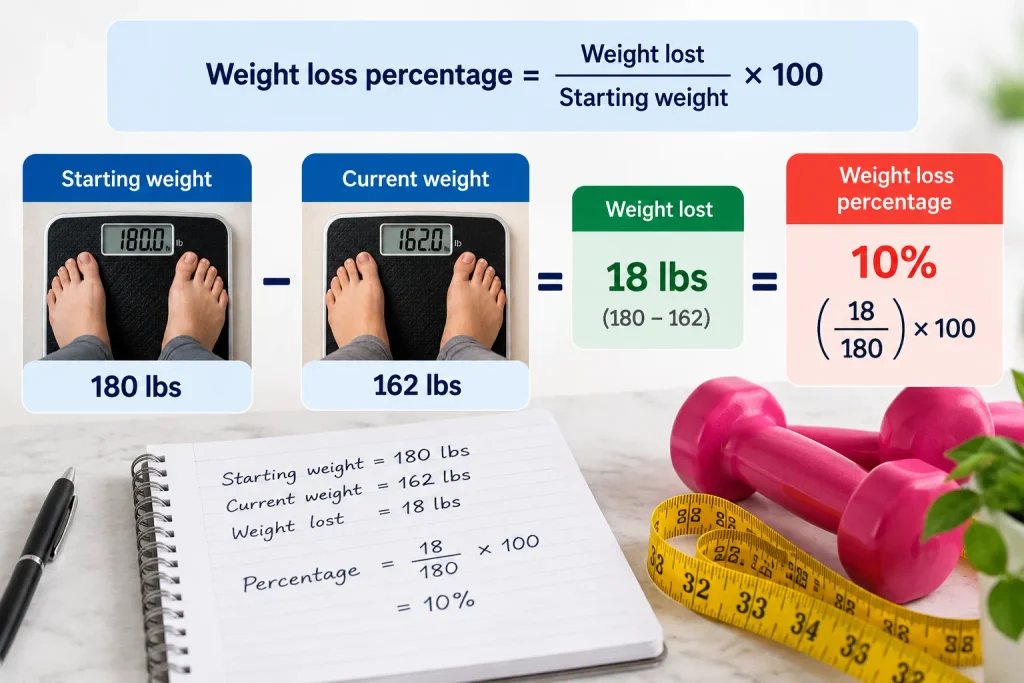
The weight loss percentage formula is based on the relationship between the amount of weight lost and the starting weight.
The calculation can be represented conceptually as:
Weight loss percentage = weight lost ÷ starting weight × 100
The amount of weight lost is found by comparing the starting and current measurements.
For example, if you started at 180 pounds and now weigh 162 pounds, you have lost 18 pounds. The 18-pound loss is then compared with the original 180-pound weight.
This produces a 10% weight loss.
The important point is that the starting weight is the reference point. The percentage is not normally calculated by dividing the lost weight by the current weight.
Percentage Weight Loss Formula: Step-by-Step
If you are figuring out percentage of weight loss manually, use this sequence.
Start with your original weight. Then record your current weight. Subtract the current weight from the original weight to determine how much weight has been lost. Compare that amount with the original weight and convert the result to a percentage.
For example, imagine these measurements:
Starting weight: 250 pounds
Current weight: 225 pounds
The difference between the two measurements is 25 pounds. The 25-pound change is then compared with the original 250-pound weight. The result is a 10% reduction from the starting body weight.
The same approach works whether you are calculating weight loss in pounds, kilograms, or another consistent unit.
How Do You Calculate Your Weight Loss Percentage?
If you are wondering how do you calculate your weight loss percentage, the process is simpler than it may first appear.
Take the weight you started with and compare it with your current weight. The difference is your total weight loss. Then determine what portion that loss represents relative to your starting weight.
For example, suppose you began at 200 pounds and now weigh 190 pounds. You have lost 10 pounds. Because 10 pounds is one-twentieth of 200 pounds, the percentage of weight lost is 5%.
This method works for small and large changes alike. The key is to use the same starting measurement throughout the calculation.
How to Calculate Percentage of Weight Loss in Pounds
Pounds can be used directly for a weight loss percentage calculation as long as both measurements are in pounds.
For example, suppose your starting weight was 210 pounds and your current weight is 195 pounds. Your total weight loss is 15 pounds.
You then compare those 15 pounds with your original 210-pound weight. The resulting percentage is approximately 7.14%.
There is no need to convert pounds into kilograms before calculating the percentage. What matters is consistency: both the starting and current measurements should use the same unit.
How to Calculate Percentage of Body Weight Loss in Kilograms
The same process applies when your measurements are in kilograms.
Suppose you started at 100 kilograms and your current weight is 92 kilograms. Your total weight loss is 8 kilograms.
The 8-kilogram loss is compared with your original 100-kilogram weight. That means your percentage of body weight loss is 8%.
You do not need a separate kilogram-specific formula. The calculation is based on a ratio, so the same method works with pounds and kilograms.
The important rule is never to mix units. Do not compare a starting weight in pounds with a current weight in kilograms unless you have converted one measurement first.
Does the Weight Loss Percentage Change With Pounds or Kilograms?
No. If the starting and current measurements are converted correctly, the percentage is the same.
For example, suppose a person starts at 200 pounds and reaches 180 pounds. That is a 20-pound loss.
If those measurements are converted into kilograms, both numbers change proportionally. The resulting percentage remains the same because the calculation compares one measurement with another using the same unit.
This is why weight loss percentage is useful across different measurement systems.
Whether you track your weight in pounds or kilograms, the important information is the proportional change from your starting weight.
How to Figure Weight Loss Percentage With an Example
A simple example makes the process easier to understand.
Imagine someone starts a weight-loss program at 240 pounds. After several weeks, their current weight is 216 pounds.
The difference between 240 and 216 is 24 pounds. The person has therefore lost 24 pounds.
The next step is to compare those 24 pounds with the original 240-pound starting weight. Because 24 is one-tenth of 240, the person has lost 10% of their starting body weight.
Now consider a different example.
Someone starts at 160 pounds and later weighs 152 pounds. The difference is 8 pounds. When that 8-pound change is compared with the original 160-pound weight, the result is a 5% weight loss.
These examples show why simply saying “I lost 8 pounds” does not provide the entire context. The percentage depends on where the person started.
How to Determine Percentage of Weight Loss Over Time
To determine percentage of weight loss over time, choose a clear starting point and use it consistently.
If you started tracking your progress at 200 pounds, that 200-pound measurement remains your baseline for calculating the percentage lost from that starting point.
Suppose your weight later changes to 190 pounds. You have lost 5% of your starting weight. If your weight later reaches 180 pounds, your cumulative percentage loss becomes 10%.
This makes it possible to see progress as a percentage rather than repeatedly resetting the calculation.
For longer-term tracking, it can also be useful to record the date, starting weight, current weight, total weight lost, and percentage of starting body weight lost.
How to Find Percentage of Weight Loss From Your Starting Weight
The starting weight is the most important reference point in a standard weight loss percentage calculation.
If you want to find the percentage of weight loss, first identify the weight at the beginning of the period you are measuring. Then compare your latest weight with that baseline.
For example, if your baseline is 190 pounds and your current measurement is 175 pounds, your total change is 15 pounds.
The percentage calculation then expresses that 15-pound change relative to the original 190-pound body weight.
This gives you a proportional measure of progress rather than an absolute number alone.
How to Work Out Percentage Weight Loss Without a Calculator
You do not need a specialized tool to work out percentage weight loss.
You can do the calculation using basic arithmetic. First find the difference between your starting and current weight. Then compare that difference with your starting weight and convert the result to a percentage.
For simple numbers, the calculation can often be done mentally.
For example, losing 10 pounds from a starting weight of 200 pounds represents 5%. Losing 20 pounds from the same starting weight represents 10%.
For less convenient numbers, using a calculator reduces the chance of arithmetic errors.
If you frequently track changes, a dedicated weight loss percentage calculator can make the process faster and easier.
Weight Loss Percentage Calculator
A weight loss percentage calculator is useful when you want an immediate result without performing the calculation manually.
A typical calculator requires your starting weight and current weight. It then determines the difference between the two values and expresses that change as a percentage of your starting weight.
For example, if you enter a starting weight of 200 pounds and a current weight of 185 pounds, the calculator can determine that the person has lost 15 pounds and express that loss as a percentage of the original weight.
For CalculatorPeak users, the most relevant place to explore available health-related calculators is the CalculatorPeak Health category.
The calculator approach is especially useful when you are comparing multiple dates or checking several hypothetical weight changes.
When Should You Use a Weight Loss Percentage Calculator?
A weight loss percentage calculator can be useful whenever you want to compare a weight change with the original body weight.
You might use it when tracking progress toward a personal goal, reviewing changes over several weeks, comparing different starting points, or simply checking what percentage of your original weight has changed.
It is also useful when the numbers are awkward. Calculating a percentage from measurements such as 187.6 pounds and 174.2 pounds is possible manually, but a calculator can reduce arithmetic mistakes.
The calculator does not change the underlying calculation. It simply performs the same weight loss percentage calculation automatically.
Why Calculate Weight Loss as a Percentage?
Weight loss in pounds or kilograms tells you how much weight changed. Percentage weight loss adds context by showing how large that change is relative to the starting weight.
Imagine two people who each lose 15 pounds. One person starts at 150 pounds, while the other starts at 300 pounds. Although both people lost the same number of pounds, the proportional change is very different.
The first person’s 15-pound loss represents 10% of their starting weight. For the second person, the same 15-pound loss represents 5%.
This is one reason percentage can be useful for tracking individual progress.
It also makes it easier to describe progress in a standardized way rather than relying only on the number of pounds or kilograms lost.
Percent of Body Weight Lost vs. Pounds Lost
Pounds lost and percent weight loss are related but answer different questions.
“Pounds lost” tells you the absolute amount of weight that changed.
“Percent of body weight lost” tells you how large that change was compared with your starting weight.
Neither measurement replaces the other.
A useful progress record can include both. For example, someone might record that they lost 18 pounds and that the change represents 9% of their starting body weight.
Looking at both numbers provides more context than either number by itself.
How to Calculate Percent Weight Loss Between Two Weights
If you have two weights and want to calculate the percentage change, first determine which one is the baseline.
For standard weight-loss tracking, the earlier or starting weight is normally the reference point. Compare the amount lost with that starting measurement.
For example, moving from 250 pounds to 225 pounds means a 25-pound reduction. The 25-pound change is evaluated against the original 250-pound measurement.
This is different from calculating the percentage difference between two arbitrary numbers. If your purpose is specifically to measure weight lost from a starting point, use the starting weight as the baseline.
Weight Loss Percentage Calculation for a Weight-Loss Goal
Percentage can also help you describe progress toward a weight-loss goal, but there is an important distinction between percentage of starting weight lost and percentage of the way to a goal.
Suppose someone starts at 200 pounds, currently weighs 185 pounds, and has a target weight of 170 pounds.
They have lost 15 pounds from their starting weight. That is the percentage of starting body weight lost.
However, the distance from the starting weight to the goal is 30 pounds, and 15 of those pounds have already been lost. Therefore, the person has completed half of the weight-loss distance between their starting point and goal.
These are two different measurements. One describes the percentage of original body weight lost; the other describes progress toward a specific target.
Keeping those concepts separate prevents confusion.
How to Calculate Weight Loss Percentage When Your Weight Goes Up
The standard calculation can also produce a negative result when your current weight is higher than your starting weight.
For example, if you began at 180 pounds and later weigh 185 pounds, there has not been a weight loss from that baseline. There has been a 5-pound increase.
For weight-loss tracking, it is usually clearer to describe this as a weight gain or increase rather than treating it as a positive weight-loss percentage.
This is another reason to label your measurements clearly as starting weight, current weight, amount changed, and percentage change.
Common Mistakes When Calculating Weight Loss Percentage
One common mistake is dividing the weight lost by the current weight rather than the starting weight. For standard percentage weight loss, the starting measurement is the reference point.
Another mistake is mixing units. If your starting weight is in kilograms and your current weight is in pounds, convert one measurement before calculating.
Rounding too early can also create small inaccuracies. If your scale gives a decimal measurement, keep the available precision during the calculation and round the final percentage instead.
Another frequent mistake is confusing weight loss percentage with body fat percentage. They are not the same measurement.
Weight loss percentage describes the reduction in total body weight relative to a baseline. Body fat percentage describes the proportion of body mass that is fat. A person can lose weight without all of the change coming from body fat.
Weight Loss Percentage vs. Body Fat Percentage
These two terms sound similar but measure different things.
Weight loss percentage focuses on how much total body weight has changed relative to a starting weight.
Body fat percentage estimates how much of your body weight consists of fat.
For example, if someone loses 10 pounds, that does not automatically mean they lost 10 pounds of body fat. Changes in body water, glycogen, muscle tissue, food volume, and fat mass can all affect scale weight.
Therefore, a weight loss percentage calculation should not be interpreted as a direct measurement of fat loss.
If you are researching body composition, use a body fat measurement or an appropriate body composition calculator rather than assuming that every pound lost represents fat.
How to Track Weight Loss Percentage More Accurately
Consistent measurement is more important than checking a percentage once.
Try to use the same scale and keep the conditions reasonably consistent. Weight can naturally fluctuate from day to day because of hydration, food intake, sodium, exercise, and other factors.
A single measurement may therefore not represent a long-term trend.
Recording measurements over time can provide a clearer picture. You can keep the date, starting weight, current weight, total weight change, and percentage change in a simple log.
For people who weigh themselves regularly, looking at trends over several measurements can be more informative than reacting to one day’s number.
Does a Daily Weight Change Mean You Lost Body Fat?
Not necessarily.
Scale weight can move up or down for reasons that are unrelated to changes in body fat. Water retention, food and fluid intake, bowel contents, and other normal fluctuations can affect the number on the scale.
That means a small change from one day to the next should not automatically be interpreted as a corresponding change in body fat.
Percentage weight loss is most useful when you define a meaningful starting point and evaluate the broader trend rather than treating every small fluctuation as a major change.
Is Percentage Weight Loss Better Than Pounds Lost?
Percentage weight loss is not necessarily “better” in every situation. It provides a different type of information.
Pounds or kilograms lost tell you the absolute change.
Percentage weight loss tells you the proportional change relative to your starting weight.
Using both measurements together can provide a more complete picture.
For example, a progress record might show that someone lost 20 pounds, representing 10% of their starting body weight. The pounds communicate the absolute change, while the percentage provides context.
How Much Is 5% Weight Loss?
A 5% reduction depends on your starting weight.
Someone starting at 200 pounds would need to lose 10 pounds to reach a 5% reduction from their starting weight.
Someone starting at 160 pounds would need to lose 8 pounds for the same 5% reduction.
This illustrates why percentage-based goals scale with the starting body weight.
The same principle applies to 10%, 15%, or any other percentage. The starting measurement determines how many pounds or kilograms correspond to that percentage.
How Much Is 10% Weight Loss?
A 10% weight loss means losing one-tenth of the starting body weight.
For a starting weight of 200 pounds, 10% corresponds to 20 pounds.
For a starting weight of 250 pounds, 10% corresponds to 25 pounds.
For a starting weight of 100 kilograms, 10% corresponds to 10 kilograms.
This is useful when setting numerical milestones because you can translate a percentage into an actual weight amount based on the starting measurement.
Is There a Healthy Percentage of Weight Loss?
There is no single percentage that is appropriate for every person or every timeframe. Weight-management goals depend on factors such as starting weight, age, health status, medications, nutrition, activity, and individual circumstances.
For health-related guidance, it is better to distinguish the mathematical calculation from medical advice.
The calculation itself can tell you how much weight has changed as a percentage. It cannot determine whether that rate or amount is appropriate for you.
If you have a medical condition, are taking medication that affects weight, are pregnant, are under 18, or have concerns about rapid or unintentional weight changes, discuss your situation with an appropriate healthcare professional.
For general evidence-based information about healthy weight management, consult resources from organizations such as the CDC and the National Institute of Diabetes and Digestive and Kidney Diseases.
Weight Loss Percentage FAQs
How do you calculate your weight loss percentage?
To calculate your weight loss percentage, compare the amount of weight lost with your starting weight. First determine the difference between your starting and current weight, then express that difference as a percentage of the starting measurement.
How to calculate percentage of weight loss?
Start with your original weight and current weight. Determine how much weight changed, compare that change with your original weight, and express the result as a percentage.
How do you figure percentage of weight loss?
To figure percentage of weight loss, use your starting weight as the baseline. The amount lost is compared with that original measurement, producing the percentage of body weight lost.
How to figure weight loss percentage?
Record your starting and current weights, determine the difference, and compare the difference with your starting weight. This gives you the weight loss percentage.
How to measure weight loss percentage?
Use consistent weight measurements and compare the amount lost with the starting weight. For longer-term tracking, record the dates and measurements so you can see how the percentage changes over time.
How to calculate weight loss by percentage?
Determine the amount of weight lost and compare it with the starting weight. A percentage expresses the weight change relative to that original measurement.
What is the weight loss percentage formula?
The standard weight loss percentage calculation compares the amount lost with the starting weight. The amount lost is the starting weight minus the current weight, and the result is expressed as a percentage of the starting measurement.
What is the difference between weight loss percentage and body fat percentage?
Weight loss percentage measures the change in total body weight relative to a starting point. Body fat percentage estimates the proportion of body weight that is fat. They are different measurements and should not be treated as interchangeable.
Can I calculate weight loss percentage in kilograms?
Yes. You can calculate weight loss percentage in kilograms using the same method used for pounds. Both measurements simply need to use the same unit.
Can I calculate weight loss percentage in pounds?
Yes. Pounds work exactly the same way. Use your starting weight and current weight in pounds and compare the change with the original measurement.
Why should I use my starting weight?
The starting weight provides the baseline against which the change is measured. Using a consistent baseline makes it possible to understand how large the change is relative to where you began.
Does losing the same number of pounds always mean the same percentage?
No. The percentage depends on the starting weight. A 10-pound loss represents a larger percentage for someone who started at a lower weight than for someone who started at a higher weight.
Can a weight loss percentage be negative?
If your current weight is higher than your baseline, the calculation represents an increase rather than a loss. The sign and direction of the result should therefore be interpreted in relation to the starting measurement.
Final Takeaway
Learning how to figure out percentage of body weight loss is a simple way to put a weight change into context. Instead of looking only at pounds or kilograms, you can see how much of your original body weight has changed.
The basic process is consistent: establish a starting weight, record the current weight, determine the amount of weight lost, and express that change relative to the starting measurement.
The same approach works for pounds and kilograms, and a weight loss percentage calculator can handle the arithmetic when you want a faster result.
Most importantly, remember that weight loss percentage and body fat percentage are different measurements. Percentage weight loss describes a change in total body weight; it does not tell you exactly how much fat, muscle, or water was lost.
For more health and wellness calculation tools, explore the CalculatorPeak Health category and use the relevant calculators alongside your own progress records.